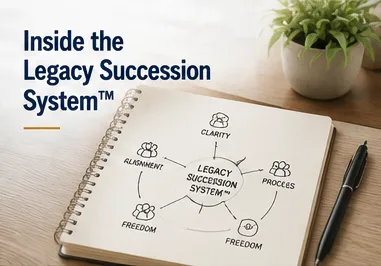
Inside the Legacy Succession System™: The Six-Module Framework
Inside the Legacy Succession System™: The Six-Module Framework
Why Most Succession Processes Are Organised Around the Wrong Thing
Most succession processes are milestone-driven: announce the succession, introduce the successor, complete the legal transfer, close. The milestones mark events. What they don't measure — and what most succession processes don't systematically build — is readiness. Whether the business, the successor, and the relationships that hold the business together are genuinely prepared for what comes after the announcement.
The gap between milestone completion and genuine readiness is where most manufacturing successions fail. The announcement happens on schedule. The legal transfer completes. And then the real challenges begin: the customer who was never properly prepared for the change, the veteran employee whose trust in the new leadership was assumed rather than built, the operational dependency on the founder that was never genuinely resolved because there was no structured mechanism for doing so.
The Legacy Succession System is organised differently — around capability development rather than milestone events. The milestones are the result of the capability work, not the measure of it. Each module builds a specific and measurable dimension of readiness before the formal transfer occurs.
Module 1: Define Your Ideal Outcome — The Legacy Blueprint
Most manufacturing founders have spent decades building their business without ever articulating explicitly what success looks like when they step back. They have a financial target and a general sense of what they hope will happen. They don't have a documented vision that is specific enough to drive the decisions that need to be made during the preparation process.
The Legacy Blueprint changes that. It is a structured process capturing the founder's complete vision of what success looks like — not just the financial outcome but the human one: who is running the business, what role the founder maintains, what the culture looks and feels like, what the relationship with the workforce continues to be, and what the founder wants to be known for having built over a career. The Blueprint also surfaces non-negotiables early — the aspects of the succession outcome the founder is not willing to compromise on — so they can be central to the design of the transition rather than discovered as constraints after key decisions have been made.
Module 2: Remove Yourself from Daily Operations — The 90-Day Extraction Plan
The 90-Day Extraction Plan maps every decision, relationship, and knowledge node currently flowing through the founder and builds the delegation structures, documented systems, and relationship transfer protocols that replace them. The process runs in three phases: four weeks of dependency mapping, six weeks of delegation and documentation implementation, and ten weeks of independence testing — including at least one extended founder absence that tests the architecture under real operational conditions. Gaps that surface in testing are addressed before they become succession vulnerabilities rather than after they have become expensive ones.
Module 3: Develop Next-Generation Leadership
The 12–24 month structured development roadmap addresses the six leadership competencies that predict successor success — crisis decision-making, veteran credibility, customer relationship ownership, financial literacy, values under pressure, and stakeholder communication — in conditions where genuine development is possible: real stakes, real consequences, structured coaching support, and documented milestones.
This module also addresses the family dynamics layer that complicates almost every founder-to-family succession. The relationship between founder and successor is a family relationship before it is a professional one, and the history of that relationship — expectations, communication patterns, unspoken assumptions about authority and deference — shapes the succession process in ways that can be either assets or liabilities depending on whether they are examined explicitly or left to operate in the background. The LSS development roadmap includes specific work on the founder-successor professional relationship to ensure that family history enables rather than complicates the development investment.
The development roadmap is not a training programme. It is a structured exposure plan — a deliberate sequence of real situations, with real stakes, in which the successor builds the specific capabilities that only field experience can develop, supported by coaching that converts experience into transferable learning rather than leaving it as accumulated events without structured reflection.
Module 4: Protect Customer Relationships — The Transition Communication Plan
The goal of this module is straightforward: 100% retention of the customers representing 80% or more of the business's revenue through the transition period. This is achievable through a structured four-stage process — Customer Relationship Audit, Successor Introduction Strategy, Transition Communication Planning, and Relationship Monitoring — when the transition is planned 18–24 months in advance. It is not achievable when customer transition is treated as a communication event rather than a relationship-building process managed across an extended timeline.
The module distinguishes between customer relationships that are institutional — tied to the business's capabilities, systems, and processes — and those that are personal, tied to the founder's individual knowledge and relationship history. Institutional relationships survive transition without active management. Personal relationships require deliberate transfer. Most manufacturing businesses have a higher proportion of personal relationships than their founders recognise, because the founder's involvement has been so consistent that the institutional and personal dimensions have never been separated in the customer's experience.
Module 5: Maximise Business Value — Valuation and Financial Readiness
Financial readiness is one module of six — important, but not the central one. The businesses that achieve strong valuations in succession transactions do so because they have addressed the operational, leadership, and relationship dimensions of succession effectively first. The financial presentation reflects genuine business quality rather than an attempt to compensate narratively for a business that is still fundamentally founder-dependent.
This module covers valuation optimisation, buyer-type decision frameworks, deal structure literacy, and pre-transaction financial preparation. The documentation, financial normalisation, and due diligence readiness work that determines how much of a transaction timeline is spent on value creation versus value recovery from a weak starting position.
Module 6: Secure Your Legacy — Governance and Values Documentation
The final module addresses the dimension of succession that most founders care about most deeply and that most succession processes address most inadequately: the preservation of what they built beyond the financial transaction.
The Legacy Governance work captures the founder's values, decision-making principles, non-negotiables, and vision for what the business should continue to be — and translates them into governance documents, leadership selection criteria, and cultural anchors that give the legacy a structured basis for surviving the transition. Not depending on the successor's memory of dinner conversations. Documented, embedded, and designed to hold up under the conditions of operating without the founder's daily presence to reinforce them.
The Investment
The Legacy Succession System is a six-month coaching partnership at $150,000 upfront and $30,000 per month thereafter. It is not a consulting report. It is an operational intervention that produces a business demonstrably more independent, a successor demonstrably more capable, and a legacy demonstrably more transferable than when we started. The owners who invest in this programme exit with confidence rather than anxiety — not because everything went perfectly, but because they built the foundation that makes imperfect moments recoverable before they needed it to be. That is what exiting right actually looks like — prepared rather than pressured, on terms the founder chose rather than terms the circumstances imposed.
Reader Challenge
Which of the six modules represents the most urgent unaddressed gap in your succession preparation right now — and what is the real cost of that gap remaining unaddressed for another 12 months?
#LegacySuccessionSystem #SuccessionPlanning #ManufacturingBusiness #FamilyBusiness #BusinessCoaching
