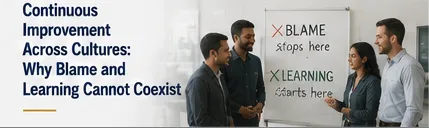
Continuous Improvement Across Cultures: Why Blame and Learning Cannot Coexist
Continuous Improvement Across Cultures: Why Blame and Learning Cannot Coexist
The Problem That Was Never Small
I was informed about a quality issue in a manufacturing facility in Southeast Asia on a Thursday afternoon. The production anomaly that generated the issue had first been noticed by someone on the production floor on the previous Monday morning. By Thursday, what had started as a detectable and manageable process variation had progressed into a confirmed product non-conformance affecting a shipment to a Tier 1 aerospace customer.
Ten days elapsed between initial detection and the information reaching a level in the organisation with the authority and resources to address it effectively. Not because nobody noticed. Not because the team lacked technical competence. Because the cultural and organisational dynamics governing escalation in that environment had built a ten-day gap between what the floor knew and what the people who could act on it were told. And that gap transformed a small problem into an expensive one.
Continuous improvement rests on a foundational operating assumption: problems surfaced early are better than problems hidden late. That assumption requires psychological safety — the genuine confidence that surfacing a problem will not cost more personally than hiding it. And psychological safety is the most culturally variable of all the conditions required for high-performance manufacturing operations. It cannot be mandated. It cannot be announced. It can only be built through sustained, consistent, visible leadership behaviour that eventually changes what the team believes will happen when they speak up.
How Cultural Dynamics Suppress Escalation
In high power-distance cultures — many of those I operated in across Southeast Asia, South Asia, and parts of the Middle East — admitting a mistake to a superior carries significant social risk within the hierarchical frame. The expectation that people with authority are competent and that people in subordinate roles are responsible for their own domain creates a dynamic in which upward problem escalation feels like self-exposure — an admission that something went wrong in your area that you were responsible for managing. The culturally rational response is to attempt resolution before escalation: to manage the problem within the team until it either resolves or becomes too large to contain. This is individually rational in many cases. At organisational scale, it consistently produces delayed escalation of problems that have grown during the delay.
The result is predictable and expensive and recurs across manufacturing operations in high power-distance environments: by the time a problem reaches the level with authority and resources to address it effectively, it is significantly larger, more costly, and more visible than it needed to be. The leader looks at the incident report and concludes the team failed to escalate. The team behaved exactly as the organisational dynamics trained them to behave. Both things are true simultaneously, and only one of them is within the leader's control to change.
In cultures with strong face-saving norms — much of East and Southeast Asia — the dynamic carries an additional dimension. Surfacing a problem is not only a risk to the individual's standing with their superior. It is a risk to the team's collective face — to the group's shared reputation for competence and reliability within the organisational hierarchy. The cultural mechanism can be to absorb problems collectively within the team until they are too large to continue absorbing without disclosure. Leaders who do not understand this dynamic will consistently be surprised by problems they should have seen months earlier, at a scale and cost that reflects accumulated undisclosed management rather than a sudden emergence.
In cultures with flatter hierarchies and stronger norms of transparency — Scandinavian and Northern European contexts in particular — the problem presents differently. The risk is not that problems won't surface. It is that they will surface with an expectation of collaborative problem-solving that doesn't survive contact with a leadership team whose actual response to bad news is blame, regardless of its stated policy about psychological safety. The gap between the stated culture and the lived one is always legible to the people experiencing it. In these environments, the gap is surfaced through the direct challenge that is culturally legitimate — but the resulting conversation is rarely comfortable.
What Leaders Have to Build Differently
The cultural complexity is real and consequential. It is not an operational excuse. The manufacturing organisations I have worked with that built genuine continuous improvement cultures across high power-distance environments did so through consistent, deliberate, and sustained leadership behaviour that eventually rewrote the social calculus of escalation. Not through policy. Not through announcement. Through demonstrated behaviour, maintained long enough to produce a new and durable shared understanding of what actually happens when a problem is surfaced.
The primary instrument is the leader's visible real-time response to bad news — not the stated policy, not the values poster, not the safety culture document. The actual observable behaviour in the room when a problem is raised for the first time, by the first person brave enough to raise it. If the leader's visible first response is frustration, blame, an analysis of fault before an analysis of cause, or a search for accountability before a search for understanding, the organisation learns immediately and precisely what surfacing problems produces in practice. The policy statement saying otherwise becomes invisible noise. The behaviour in the room is the actual policy — the one that governs team behaviour in the next situation that arises.
Three specific leadership behaviours consistently produce the cultural shift from problem-hiding to problem-surfacing, when sustained across sufficient time and sufficient situations to build a new prior.
The first is asking for problems before asking for performance. When every operational review leads with performance metrics and problems are addressed only in the time remaining, the implicit hierarchy is clear: performance is what is valued, and problems are what is tolerated. When reviews lead with 'what problems did we encounter this week and what did we learn from them?' the hierarchy reverses: problems are expected, invited, and understood as the primary vehicle through which performance genuinely improves over time. That reversal, maintained consistently, is one of the most powerful signals a leader can send about what the culture actually values.
The second is visibly absorbing bad news without blame. Not performing patience — actually demonstrating, consistently and visibly, that the first response to a surfaced problem is curiosity about cause rather than identification of fault. The leader who responds to 'we have a significant problem' with 'tell me what happened and what you've already tried' rather than 'who is responsible for this?' creates an information environment that is fundamentally different from the one that produces ten-day escalation delays. This behaviour, maintained consistently across dozens of situations over months, gradually changes what the team believes surfacing a problem actually produces — which is the only change that matters.
The third is closing the loop explicitly and consistently. Every problem that is surfaced, acknowledged, and then allowed to quietly disappear without visible resolution or follow-through teaches the team that surfacing problems is futile — that the personal social exposure it generates does not produce the operational improvement that would make the exposure worthwhile. The leaders who build genuine improvement cultures close the loop in ways the team can observe: this problem was raised, this is what we investigated, this is what we changed, this is how we will know whether the change worked. That loop, maintained across dozens of problems over months and visible to the people considering whether to surface the next one, is the mechanism through which the cultural shift becomes self-sustaining.
The First Three Times Are the Foundation
The most important moments in any cultural shift toward continuous improvement are the first three times someone surfaces a problem and observes what happens next. Those three moments set a prior that persists for months — sometimes significantly longer — regardless of what the policy documents say or what the leadership team believes about the culture they have built.
If the response to the first three surfaced problems is genuine curiosity, visible action, and explicit acknowledgement — this is what you raised, this is what we investigated, this is what we changed — the organisation begins updating its understanding of what escalation actually produces. The update is slow and requires repetition across different people and different problem types to become a robust prior. But it happens.
Continuous improvement is not a methodology that can be installed through a programme. It is a culture built on specific social conditions that allow problems to surface when they are small, be examined honestly without the social cost of blame, and be resolved in ways the organisation can observe and learn from collectively. Building those conditions requires leaders who understand the cultural dynamics at play in their specific environment, who are willing to examine their own real-time responses to bad news with the same rigour they apply to the problems themselves, and who are patient enough to understand that the cultural shift takes longer than the policy change. The return — an organisation that finds problems when they are small and cheap rather than when they are large and expensive — is one of the most durable and most operationally significant competitive advantages available in manufacturing.
Reader Challenge
What does your team currently believe will happen if they surface a problem early — and how do you actually know that? Not what you believe they believe. What specific data do you have about the real social calculus operating in your team right now?
What to do next
📗Entry point: Leading with Character Across Cultures, Edition 2 — on Amazon or bjornvikard.com
🎓Go deeper: Character-Driven Leadership — 6-module online programme with workbook — $397 at bjornvikard.com
🤝1:1 Coaching: CDLM™ individual mentoring — from $8,000 — enquire at bjornvikard.com
#ContinuousImprovement #Leadership #CrossCulturalLeadership #PsychologicalSafety #LeadingWithCharacter
