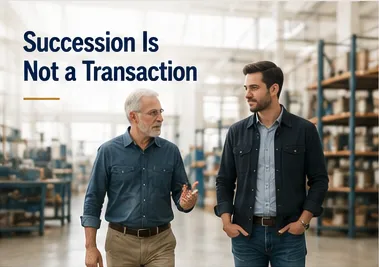
Succession Is Not a Transaction. It Is a Leadership Test.
Succession Is Not a Transaction. It Is a Leadership Test.
The Difference Nobody Names Until It's Too Late
Running a business and leading a business are not the same thing. Running it means keeping operations moving — ensuring production targets are met, orders are shipped, suppliers are paid, and the routine machinery of operations continues functioning. Most operationally experienced people can run a business given sufficient knowledge of how it works.
Leading it means something different and considerably more demanding. Making decisions under genuine uncertainty, where the information is incomplete and the cost of getting it wrong is real and visible to the organisation. Holding a culture together when the market turns difficult and the team is looking upward for signals about whether to stay confident or start worrying. Earning the respect of people who knew the business before you did — veterans whose scepticism of new authority is entirely legitimate and whose trust is not inherited with the title.
Most succession plans test the first capability. They give the next generation exposure to operations, involvement in decisions, and familiarity with systems — often with a safety net that catches the real consequences before they land fully. Almost none systematically develop the second. And the gap between the two becomes visible at the worst possible moment: after the transfer, when the safety net has been removed and the first genuine leadership test arrives.
Why Exposure Is Not Development
The most common family business development approach I encounter is exposure-based: bring the next generation into the business early, give them experience across departments, involve them in significant meetings and decisions, let them observe how the founder operates. This is better than not doing it. It is not sufficient preparation for the leadership demands that consistently determine whether successions succeed or fail.
The problem is structural. In an exposure-based approach, the successor is present for decisions but rarely carries them independently. They observe crises but the founder manages them. They participate in customer meetings but the founder owns the relationship and the room. They work alongside veterans but the founder's authority provides the relational context that makes those interactions function. The successor builds genuine familiarity with what leadership looks like. They do not build the personal experience of what it requires when the decision is genuinely theirs and no backstop is available.
When the formal transition happens and the safety net is removed, the gap becomes visible. The successor who appeared ready — who had years in the business, good judgment in supported decisions, and genuine respect from the founder — faces a set of demands their development has not actually prepared them for. Discovering this after the transition is far more expensive than discovering it during a structured programme that was specifically designed to surface and address it before it matters most.
The Six Competencies That Predict Successor Success
Across multiple family manufacturing business successions, six specific leadership competencies consistently distinguish successors who navigate the transition successfully from those who struggle in ways that cost the business and the family.
The first is crisis decision-making under real pressure. Not simulated pressure or supported guidance — actual crises where the outcome is genuinely uncertain, the cost of getting it wrong is visible to the organisation, and the successor is the person with the authority and the accountability. A quality failure with a Tier 1 customer. A production disruption with a delivery commitment at risk. Has the successor led through these independently — where independently means without the founder as an available backstop who would actually intervene if things were going seriously wrong?
The second is veteran management and floor credibility. The 25-year machinist who has seen three generations of a family cycle through the business does not automatically respect the founder's son or daughter. That respect is earned through specific and visible demonstration: technical knowledge sufficient to be taken seriously, fair treatment experienced consistently rather than announced, and the willingness to listen before deciding in situations where the veteran's experience genuinely matters. Successors who inherit positional authority without building genuine floor credibility find the first two years of their leadership shaped by passive resistance they can neither see clearly nor address directly.
The third is customer relationship ownership. Moving a major manufacturing customer relationship from founder to successor requires a structured handover across multiple touchpoints over months — not a joint call where the founder does most of the talking, and not an email introduction that the customer reads as courtesy rather than genuine transition. The successor needs to have solved real problems for the customer independently, delivered on commitments without the founder's involvement, and been the person the customer reaches out to when something goes wrong — before the formal handover transfers the title.
The fourth is financial literacy at owner level. Understanding P&L, working capital, covenant compliance, and the financial model from an owner's perspective rather than a manager's is the most consistently underdeveloped competency in family business successors. Operators understand revenue and cost. Owners need to understand the relationship between operational decisions and enterprise value, the capital structure implications of growth choices, and the financial covenant dimensions that determine strategic flexibility. The gap between operator-level and owner-level financial understanding is significant and takes time to close through structured exposure.
The fifth is values-based decision-making under genuine pressure. When the pressure is real and the easy choice conflicts with the right one — when keeping a customer happy requires compromising a quality standard, or maintaining a relationship requires tolerating behaviour that conflicts with the culture — what does the successor do? This cannot be assessed in a workshop or demonstrated in a case study. It must be built through repeated exposure to real situations where the values are genuinely tested, with structured debrief that examines the decision-making process rather than just the outcome.
The sixth is stakeholder communication under uncertainty. The ability to communicate clearly, honestly, and with genuine authority during periods when information is incomplete and the audience is anxious is the defining competency that separates successors who build rapid organisational confidence from those who inherit relationships and gradually erode them. It requires clarity about what is known, honesty about what is not, and the personal credibility that comes only from demonstrated consistency over time.
Building a Development Roadmap That Actually Develops
The 12–24 month structured development roadmap the Legacy Succession System builds for each successor is organised around deliberate, supported exposure to all six competencies under conditions where genuine development is possible: real stakes, real consequences, and structured support that allows mistakes to be examined and learned from rather than managed around.
The goal is not to accelerate the timeline for reasons of family comfort or business convenience. It is to ensure that when the formal succession date arrives, the successor has genuine capability rather than the appearance of it. The difference between the two is invisible until the transition is complete — and then it is the most important variable determining what the first two years look like for everyone involved.
Successors who go through a structured development programme with real stretch and real support consistently report the same experience: the process of being genuinely stretched, genuinely supported, and genuinely prepared is the foundation on which their leadership identity is built. Not 'I'm the founder's daughter' — but 'I earned this.' That shift in self-understanding is not cosmetic. It is what the organisation observes in the successor's behaviour, and it is what determines whether the transfer of respect from the founder to the successor actually happens rather than merely being announced.
Reader Challenge
Against the six competencies — crisis decision-making, veteran credibility, customer ownership, financial literacy, values under pressure, and stakeholder communication — score your successor honestly from 1 to 5. Where are the gaps that need a structured programme, not more time in the building?
#SuccessorReadiness #FamilyBusiness #ManufacturingLeadership #SuccessionPlanning #LeadershipDevelopment
