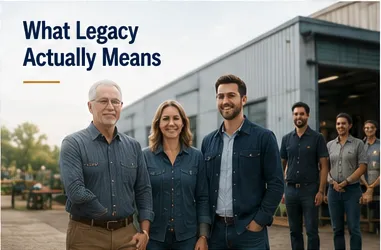
What Legacy Actually Means in a Manufacturing Business
What Legacy Actually Means in a Manufacturing Business
The Question Founders Can't Always Answer
I ask every manufacturing founder the same question in our first serious conversation: what are you actually trying to preserve?
The financial answer comes quickly. Adequate proceeds to fund retirement. A fair price for what they've built. Appropriate security for the family. Those are real and legitimate goals — and they are almost never the complete answer to the question, even when they are the first answer given.
When I press deeper — when I ask what happens to the 34-year machinist whose professional identity is built around this business, when I ask about the culture the founder spent twenty years building in a specific way for specific reasons, when I ask about the community relationships and the supplier partnerships and the way this business treats people — a different conversation begins. The founder who started with 'fair price for what I built' often ends up at 'I need to know what happens to the people who made this what it is.'
That is a legacy question. And it requires a different answer than a financial succession plan is designed to provide.
The Three-Part Definition
Legacy in a manufacturing business has three distinct components, each of which requires different preparation work and different governance structures.
The first is operational continuity — what continues running, at what standard, under what systems. This is the dimension most succession plans address: quality systems, production processes, customer relationships, supplier agreements. The goal is a business that continues producing results after the founder has stepped back. Operational continuity is necessary but insufficient. A business can continue operating at a similar performance level and still lose the things the founder cared most about.
The second is cultural preservation — how people are treated, how decisions are made in grey-zone situations, what the organisation values in its behaviour rather than in its values posters. This is the dimension most succession plans fail to address structurally. Culture is transmitted by example over time — it cannot be written into a legal document and preserved by reference. When the person whose behaviour set the cultural standard steps back, the culture either continues because the next generation of leaders internalised it, or it drifts because they didn't and no structural mechanism exists to anchor it.
The third is workforce protection — what happens to the people who built this business alongside the founder, particularly those with long tenure and limited mobility. Workforce protection doesn't mean employment guarantees — which are neither practical nor honest in most situations. It means that the succession plan considered the workforce impact explicitly and designed the transition in ways that respect the loyalty and contribution of the people who made the business what it is.
Why Cultural Legacy Is the Hardest to Preserve
Operational continuity can be preserved through documentation, system design, and governance. Financial legacy can be preserved through legal structure and careful transaction design. Cultural legacy is harder, because culture is transmitted through behaviour rather than documentation — through the daily decisions of the people in authority that, over years, accumulate into the lived experience of what this organisation is and how it operates.
The culture of a manufacturing business is built slowly and specifically. How the founder responded when a quality problem surfaced — was the first instinct accountability or problem-solving? How the founder treated the lowest-paid person in the building. Whether commitments to the workforce were kept when keeping them was inconvenient. Whether the business behaved the same way toward suppliers during good conditions and bad ones. These behaviours, observed and experienced across years by the people in the organisation, create the culture that is the business's actual competitive advantage in workforce retention and operational performance.
That culture is not preserved by writing it down. It is preserved by developing a successor and a next-generation leadership team who have internalised it deeply enough to transmit it through their own behaviour — and by creating governance structures that give those values institutional weight rather than leaving them dependent on individual memory and personal commitment.
The Legacy Governance Documents
The Legacy Succession System's governance work produces four documents that give legacy preservation a structural rather than aspirational basis. The first is the Founder's Values Statement — not a marketing document, but a specific, operational articulation of the non-negotiables: the principles the founder would not compromise under any business pressure, and the explanation of why these specific principles matter, grounded in the founder's actual experience of building the business.
The second is the Cultural Operating Standards document — a description of how the business is expected to behave in specific categories of situation. How quality problems are managed. How performance concerns are addressed with employees. How supplier relationships are maintained under cost pressure. How customers are treated when delivering bad news. These are the grey-zone situations where culture is actually lived rather than stated, and documenting the expected behaviour gives the successor a reference point when their own instincts conflict with what they know the founder would have done.
The third is the Leadership Selection Criteria document — the specific attributes and demonstrated behaviours the founder expects in the people who lead this organisation going forward, with the reasoning behind each criterion. This document matters most in the second generation of succession: when the person the founder directly developed is selecting their own next-generation leadership, the criteria the founder articulated provide an anchor for decisions made without the founder's direct input.
The fourth is the Legacy Review Protocol — a structured annual or biennial process in which the business's leadership assesses how well the cultural standards are being maintained against the Founder's Values Statement, with explicit provisions for who conducts the review, what the evidence base is, and what the response process looks like when drift is detected. This is the governance mechanism that gives legacy preservation institutional structure rather than depending on the successor's personal commitment, which is real but not the same as a documented process.
What Legacy Is Not
Legacy is not control after you leave. The founder who builds legacy governance mechanisms as a way to retain influence over a business they have formally transferred has not actually transferred it. The documents above are not control instruments — they are reference instruments. They exist to give the successor access to the founder's values and reasoning when they face decisions the founder is no longer present to consult on, not to bind the successor to decisions the founder would have made in conditions that no longer exist.
The founder who genuinely trusts the successor they developed — because the development work was real and the values transmission was genuine — does not need control mechanisms. They need reference mechanisms that honour the foundation the business was built on and give the next generation a specific and documented starting point. The distinction between these two things is the difference between a legacy that enables and one that constrains. The first builds businesses that last. The second generates conflict that erodes them.
Reader Challenge
Write a specific, operational answer to three questions: What do you want to continue operating in this business 10 years after you step back? Who do you want leading it, and what does their leadership look like? What principles do you want governing the decisions they make? The gap between your current succession plan and those three answers is what the Legacy Governance work needs to close.
What to do next
📅Discovery call: Book a no-obligation 30-minute conversation — bjornvikard.com
📘Book: Don't Exit Wrong — Amazon and bjornvikard.com
#Legacy #ManufacturingBusiness #FamilyBusiness #SuccessionPlanning #LegacySuccessionSystem